Personal injury marketing should connect the matters a firm can accept with accurate service pages, verifiable lawyer and office information, and an intake process that distinguishes a relevant inquiry from a total call count. It should not treat search position as proof of legal skill, imply that every inquiry is a viable matter, or promise a recovery, ranking, signed case, or return on marketing spend.
This guide consolidates search, local visibility, paid media, content, referral traffic, and intake into one operating plan. It is marketing guidance, not legal, professional-conduct, privacy, advertising, or medical advice. The firm remains responsible for confirming its services, jurisdictions, fees, claims, intake questions, privacy notices, and review requirements with the appropriate lawyers and other qualified reviewers.
Small World Marketing sells marketing and website services to law firms. That commercial interest is why this page separates platform documentation, regulator guidance, published case-study evidence, operating recommendations, and decisions only the firm can approve.
Define matter fit before choosing a channel
The useful starting point is not a keyword list. It is a written definition of the work the firm can accept. That definition may include matter type, jurisdiction, incident location, date range, conflict constraints, capacity, language, and the stage at which the firm will consider an inquiry.
Do not assume that a broad phrase such as "personal injury" accurately describes every service. One firm may accept motor-vehicle matters in a particular province or state, while another focuses on different claims or serves a different geography. The website and campaign should use the firm's approved language rather than a vendor's generic category list.
For each proposed page or campaign, record:
- the matter or client task it addresses;
- the jurisdiction and service geography;
- the responsible lawyer or team;
- the evidence supporting every firm-specific claim;
- the contact route and fields required at the first step; and
- the intake classification that will show whether the inquiry fit.
The blank personal injury marketing page and intake map is designed for that inventory.
| Matter or client task | Page purpose | Evidence and reviewer | Intake route |
|---|---|---|---|
| Firm-approved injury service | Explain whether the firm handles the service and where it can act | Responsible lawyer confirms scope, terminology and jurisdiction | Short inquiry route with approved matter category |
| Location or office information | Explain genuine service coverage and how the office operates | Address, staffed hours, service area and profile ownership verified | Route by actual office or service team |
| Lawyer selection | Show who may work on the matter and relevant verifiable experience | Biography, call jurisdiction, role and credentials checked | Conflict check before detailed facts |
| First-call preparation | Explain what information the firm wants at the first step | Intake manager and responsible lawyer approve the list | Phone or form with minimal required fields |
| Existing client or document delivery | Direct an existing relationship to the correct secure channel | Firm verifies portal, authentication and support process | Do not use the public lead form for documents |
These rows are examples of a planning structure, not a list of services the firm should claim.
Use one page architecture for SEO and marketing
The approved briefs for personal injury marketing and personal injury SEO point to the same destination because the reader and operating task overlap. Creating a second near-duplicate page for "SEO" would split the firm's evidence and internal links without creating a distinct service.
A practical architecture usually includes:
- one clear personal injury overview or service page;
- distinct matter pages only for services the firm accepts;
- genuine office or service-area pages with unique local evidence;
- lawyer biographies linked to the services those lawyers actually provide;
- selected question pages that answer recurring, anonymized client tasks;
- case studies or testimonials only where the firm can use and substantiate them; and
- a discreet contact path that works on phone and desktop.
The law firm marketing hub explains the broader operating model. The law firm SEO services guide and legal practice-area page guide cover proposal scope and page review in more detail.
Google's people-first content guidance recommends creating useful content for an intended audience rather than producing pages primarily to manipulate search rankings. A personal injury page should therefore answer a real decision: whether the firm may be relevant, what it handles, who can help, what happens after contact, and what information should wait until the firm provides a secure route.
Give each channel a defined job
Organic search, local profiles, paid media, referrals, and direct visits can all lead to the same page or phone line. They do not create the same evidence, cost, or intent. Define a job and an owner for each channel before comparing performance.
| Channel | Target matter and page | Useful first measure | Important limit |
|---|---|---|---|
| Organic search | Approved service or question page | Search impressions, clicks and relevant landing-page visits | A click is not an accepted inquiry or retained matter |
| Local visibility | Genuine firm or practitioner profile linked to the correct location page | Profile interactions and accurately routed calls | Profile eligibility and office facts must be verified |
| Paid search | Narrow campaign mapped to an approved service and location | Spend, clicks, contact actions and tracked inquiries | Platform attribution does not establish matter fit or revenue |
| Referral and partner traffic | Specific referral page or direct contact route | Identified referral source and completed intake | Referral terms and professional duties require firm review |
| Direct and brand traffic | Homepage, biography, case study or contact page | Navigation path and contact action | Brand demand may have been created by several earlier channels |
The table is a measurement framework, not a claim that every channel is appropriate for every firm.
Paid campaigns should not start with a broad promise to "get more cases." They should start with approved service language, a real budget, geographic controls, working landing pages, a tested contact route, and an intake classification. If the firm cannot identify whether a contact matched its matter criteria, it cannot responsibly compare campaign quality.
Build matter pages from evidence, not assumptions
A service page needs more than a phrase and a city name. It should show:
- the approved service and jurisdiction;
- the reader task the page addresses;
- the lawyer or team connected to the service;
- the firm's actual process for an initial inquiry;
- primary sources when they help explain a current public process;
- a review date and maintenance trigger; and
- contextual links to related services, lawyer information, locations, and contact options.
Question content can come from anonymized intake patterns, search performance data, and lawyer interviews. Never copy client emails, forms, calls, medical details, accident facts, or file material into a topic list. Several ordinary details can identify a person when combined.
Google's link guidance recommends crawlable links and descriptive anchor text. A matter page should link to the most relevant lawyer, location, evidence, and contact destination using text that explains where the reader is going. A footer link alone does not provide the same context.
The law firm content marketing guide explains source, review, rights, and refresh controls for a larger publishing program.
Review every outcome, fee and superiority claim
Personal injury marketing often uses case results, settlement language, testimonials, awards, experience, fee descriptions, and comparisons. Each statement needs an owner, source, permitted context, and review date.
Do not publish assumed case values, average recoveries, win rates, referral payments, or contingency-fee terms. Do not transform one historical result into a prediction. If a firm uses a result or testimonial, its responsible reviewer must confirm that the statement, context, consent, disclaimer, and placement comply with the rules that apply to the firm.
The Law Society of British Columbia's Chapter 4 is one provincial example. It applies marketing rules to activities undertaken or authorized by a lawyer and addresses content that is false, inaccurate, unverifiable, reasonably capable of misleading, or contrary to the public interest. Other jurisdictions have their own rules and interpretations.
The Competition Bureau also explains that the general impression of a representation matters alongside its literal meaning. That is a useful reason to review a full page, headline, image, call to action, and disclaimer together rather than approving isolated sentences.
A claims register can record:
- the exact claim;
- the public source or internal evidence;
- the person who verified it;
- the approval and expiry date;
- required context or disclaimer; and
- the event that should trigger removal or re-review.
This process does not replace a lawyer's approval. It makes the material easier for the firm to review.
Keep local profiles tied to real offices and practitioners
Google's Business Profile guidelines require an accurate real-world business name and contain specific rules for practitioners, virtual offices, co-working spaces, and customer-facing locations. A profile is not a substitute for an office the firm does not operate.
For every firm or practitioner profile, document:
- the entity and person represented;
- the verified owner and authorized managers;
- the exact public name and primary category;
- the real address, staffed hours and customer-facing status;
- the main and tracking phone-number ownership;
- the linked website page;
- holiday and closure updates; and
- the recovery and escalation process.
The firm should decide whether a location page describes an actual office, a permitted service area, or neither. Do not create a page that merely swaps a city name. The local SEO guide for Canadian law firms and Google Business Profile guide provide a fuller control checklist.
Collect less at the first contact
An injury inquiry may include health, financial, employment, insurance, identity, and incident information. The public form should not invite a complete medical or accident history by default.
The Office of the Privacy Commissioner of Canada says health and financial information will generally be sensitive and that sensitivity depends on context. Its meaningful-consent guidance also says organizations should make key information understandable and generally seek explicit consent for collections, uses, or disclosures involving sensitive information, unexpected practices, or meaningful residual risk.
That guidance does not determine which privacy law applies to a particular firm or make a form compliant. A qualified reviewer must decide what the firm can collect, why it needs the data, how consent works, where the information goes, who can access it, how long it is retained, and what happens after an incident.
A first-step form might ask only for an approved matter category, jurisdiction or incident location, a conflict-check name set if required, and a safe contact method. Detailed narratives, records, photographs, identification, and medical documents can wait for the firm's approved secure process.
The site should accurately explain:
- whether contacting the firm creates any relationship;
- whether a conflict check is required;
- what not to send through the public form;
- when and how the firm may respond;
- whether voicemail, text, or email is safe for the person;
- the route for existing clients; and
- what to do if the firm does not monitor the channel for urgent needs.
Do not invent round-the-clock availability. If a phone or form is not monitored continuously, the page should not imply that it is.
Connect marketing observations to intake decisions
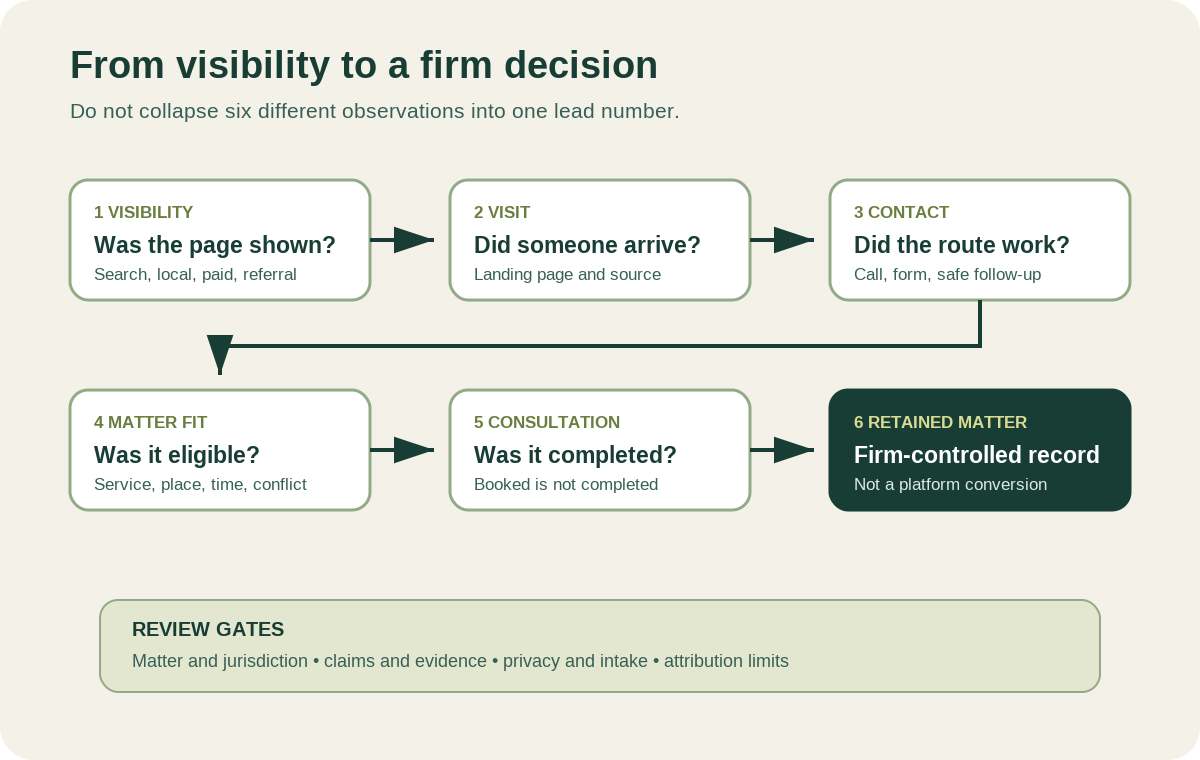
An impression, click, session, call, form submission, consultation, accepted matter, signed retainer, and fee are different observations. Combining them into a single "lead" number makes it difficult to see what changed.
Google Search Console's Performance report displays clicks, impressions, click-through rate, and average position under its documented counting rules. Google Analytics defines generate_lead as a form submission or request for information. Neither platform decides whether a contact fit the firm's services, whether a consultation occurred, or whether the firm accepted the matter.
| Stage | Recorded signal | Owner and quality check | Decision it can support |
|---|---|---|---|
| Visibility | Search impression, local profile view or paid impression | Channel owner checks date range, filters and source | Whether the approved page appeared in the measured channel |
| Visit | Landing-page session or click | Analytics owner checks consent, attribution and duplicate rules | Whether measured visitors reached the intended page |
| Contact | Call, form or other approved action | Website and phone owners test routing and spam handling | Whether the contact path worked |
| Matter fit | Accepted service, jurisdiction, timing and conflict status | Intake manager applies a documented classification | Whether campaign targeting and page scope need adjustment |
| Consultation | Scheduled and completed consultation | Firm system owner separates booked, completed and cancelled | Whether follow-up and capacity are working |
| Retained matter | Firm-defined engagement record | Authorized firm owner, with privacy and access controls | Business analysis using the firm's actual records |
Marketing reports should show the underlying counts, date range, exclusions, attribution model, and any tracking change. A percentage without its baseline can be misleading.
Use case studies as historical evidence, not forecasts
Small World Marketing publishes a search case study for The Clark Law Office, a personal injury firm in Lansing, Michigan. The published 2026 snapshot reports more than 140 keywords in Google's top three and an estimated roughly 4,000 monthly organic visits, with Ahrefs named as the source.
Those figures describe that site, market, source, and date. They do not establish inquiry quality, retained cases, revenue, or what another firm will achieve. Search-tool estimates are not the same as first-party analytics. A proposal should separate the historical case study from the work, assumptions, budget, evidence, and measurement plan for the prospective firm.
Release and maintain the system
Before publishing or launching a campaign:
- confirm matter scope, jurisdiction, geography, capacity, and responsible lawyer;
- map each channel to an approved page and contact route;
- verify firm, lawyer, office, fee, result, testimonial, and availability claims;
- review intake fields, consent, conflict checks, routing, retention, and secure follow-up;
- test canonical metadata, indexing controls, sitemap inclusion, internal links, forms, phone links, confirmations, analytics events, keyboard access, table scrolling, and phone layout;
- record source dates, approvals, owners, and maintenance triggers; and
- report visibility, visits, contacts, matter fit, consultations, and retained matters separately.
Useful maintenance triggers include a lawyer or office change, a service no longer accepted, an intake-capacity change, a profile suspension, a professional-rule update, a platform-policy change, broken tracking, or a material change in inquiry fit.
What a defined engagement should produce
A useful personal injury marketing engagement should produce owned and reviewable outputs, not an outcome guarantee. Depending on scope, those outputs may include:
- a matter, jurisdiction, geography, page, and intake inventory;
- a channel-to-page campaign map;
- lawyer-reviewed service and question pages;
- a claims and evidence register;
- local profile ownership and office controls;
- a privacy-aware intake map for qualified review;
- tested analytics and intake definitions;
- a release receipt and maintenance plan; and
- reporting that separates channel observations from firm decisions.
Small World Marketing can help plan, write, build, and measure this system. The firm must provide accurate service information, responsible reviewers, relevant platform access, and timely approvals. Contact Small World Marketing to discuss a defined scope.
Sources and limits
Primary sources checked November 16, 2026:
- Law Society of British Columbia: Chapter 4, Marketing of Legal Services
- Competition Bureau Canada: false or misleading representations
- Competition Bureau Canada: the general impression test
- Office of the Privacy Commissioner of Canada: meaningful consent
- Office of the Privacy Commissioner of Canada: sensitive information
- Google Business Profile: guidelines for representing your business
- Google Search Central: people-first content
- Google Search Central: link best practices
- Google Search Console: Performance report
- Google Analytics: recommended events
These sources provide a Canadian general-marketing reference, one provincial lawyer-marketing example, federal privacy guidance, and platform documentation. They do not resolve the rules, facts, fees, advertising requirements, or professional duties for every firm or jurisdiction. The firm's qualified reviewers must approve the final use of claims, intake, and campaign materials.