Family law marketing should help a person understand whether a firm handles the problem they are facing, where it can act, who may work on the matter, and how to make contact without disclosing more than the firm needs at the first step. It should not promise a legal result, imply that search visibility proves legal skill, or turn a difficult family transition into an aggressive sales pitch.
This guide is for law firms and the people responsible for their websites. It explains a practical content, local visibility, and intake framework. It is marketing guidance, not legal, professional-conduct, privacy, or safety advice. Each firm remains responsible for having its lawyers and other qualified reviewers approve claims, jurisdictional wording, intake questions, privacy notices, and urgent-contact instructions.
Small World Marketing provides marketing and website services to law firms. That commercial interest is why this page separates published evidence, platform guidance, operating recommendations, and firm-specific decisions.
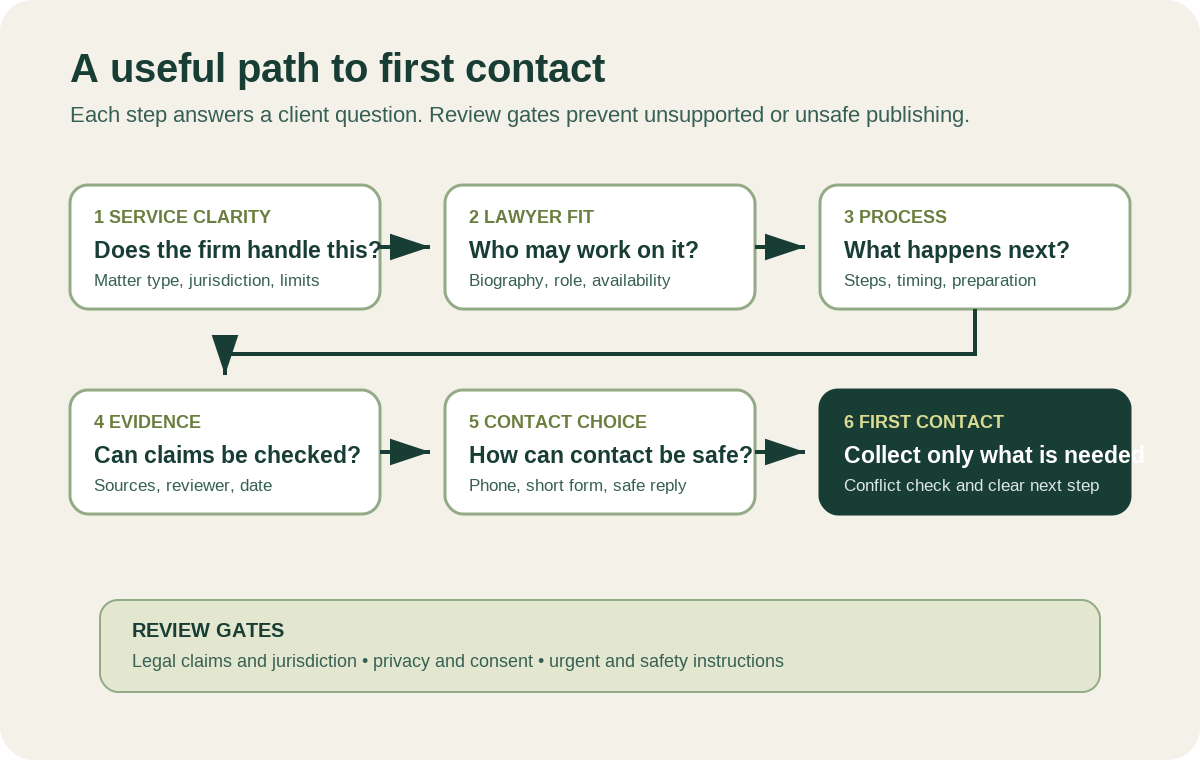
Start with accepted matters, jurisdiction and client task
The phrase "family law" can cover different services depending on the firm, lawyer, jurisdiction, and stage of a matter. Justice Canada explains that federal, provincial, and territorial governments share responsibility for family law. Its family-law materials discuss divorce, separation, parenting arrangements, child support, and spousal support, but the firm's own pages must reflect the services it actually accepts and the law that applies where it practises.
Before writing a page, record three facts:
- the matter types the responsible lawyer accepts;
- the geographic and court jurisdiction the firm can serve; and
- the client task the page should help with, such as understanding a service, preparing for a first call, or finding the right contact route.
That inventory prevents a common content problem: a page attracts a broad query but cannot tell a reader whether the firm is a plausible fit. It also gives the reviewer a concrete list of claims to approve.
The following worksheet structure can be adapted to the firm. Blank rows are included in the family law page and intake map worksheet.
| Service or situation | Client question the page should answer | Page evidence and reviewer | First-contact route |
|---|---|---|---|
| Divorce and separation | Does the firm advise on this issue in my jurisdiction? | Responsible lawyer confirms service scope and terminology | Discreet consultation request with conflict-check fields |
| Parenting arrangements | What work does the firm accept and what should I bring to a first meeting? | Lawyer-reviewed explanation and links to current primary sources | Call or short form, with an urgent-safety route defined by the firm |
| Child or spousal support | Does the firm advise payors, recipients, or both? | Accepted-matter statement and jurisdiction review | Short form that avoids collecting a full history |
| Agreements | Does the firm prepare, review, negotiate, or advise on this agreement type? | Named service owner and review date | Consultation request with document-transfer instructions after intake |
| Family mediation or collaborative process | Is this service offered, and by whom? | Credentials and service availability verified by the firm | Route to the appropriate professional or team |
This is not a list of services every family law firm should claim. Delete rows the firm does not accept and add only services that a responsible lawyer has confirmed.
Build a page set around decisions, not keyword variations
A useful page set usually has one clear service page for each material service the firm offers, supported by lawyer biographies, location information, process explanations, and a small number of genuinely helpful articles. It does not need a near-duplicate page for every wording of the same query.
Google's people-first content guidance says content should be created primarily to help people, not to manipulate rankings. For a family law site, that means a page should do work that a generic search-results summary cannot:
- define the service the firm actually provides;
- explain the jurisdiction and any material scope limits;
- introduce the lawyer or team responsible for the service;
- show what happens after a person contacts the firm;
- identify what information should not be submitted in an initial form;
- link to current primary sources where they help a reader; and
- state who reviewed the page and what would trigger an update.
A hub page can give an overview and link to the service pages. Each service page should then link to the most relevant lawyer biography, office or service-area page, related explanatory content, and a contact route. Descriptive anchor text is better than repeated "learn more" links because it tells readers where the link goes. Google's link guidance also recommends crawlable links and meaningful anchor text.
For the operating model behind this work, see law firm marketing, law firm content marketing, and the guide to legal copywriting for practice area pages.
Turn real questions into reviewed content without exposing confidences
The firm's intake team often hears the language prospective clients use. That can help identify unclear service pages, but it is not permission to publish a person's facts. Work from anonymized patterns, not case stories copied from emails, forms, calls, or files.
Use a controlled topic process:
- Ask intake staff to record a general question pattern without names, dates, locations, opposing parties, or distinctive facts.
- Confirm that the firm accepts the related matter.
- Decide whether a service page, FAQ, article, email template, or intake script is the right answer.
- Research the answer from current primary sources.
- Assign a responsible lawyer to review the legal substance and examples.
- Record the source-check date and a maintenance trigger.
The law firm blog topic ideas guide includes a fuller topic-selection method. For family law, the threshold for including a client example should be especially cautious because several ordinary facts may become identifying when combined.
Make lawyer and firm evidence specific
Trust content is strongest when a reader can verify it. Useful evidence may include current lawyer biographies, jurisdictions of call, languages offered, professional roles, published articles, verifiable case-study context, and a plain description of the firm's process.
Avoid superlatives and outcome language that cannot be supported. The Law Society of British Columbia's Chapter 4 is a useful provincial example: its marketing rules address statements that are false, inaccurate, unverifiable, reasonably capable of misleading, or contrary to the public interest. Other jurisdictions have their own rules and interpretations. The responsible lawyer should review the rules that apply to the firm rather than treating a marketing vendor's checklist as approval.
Where a page refers to a result, credential, testimonial, award, years of experience, office, or language, keep the source and verification date. Remove or qualify the claim if the source cannot be produced.
Small World Marketing has published search case studies for Fleetwood Family Law, Ali Family Law, and Brown Family Law. They are historical examples from specific engagements. They do not forecast traffic, inquiries, clients, or revenue for another firm.
Treat local visibility as an entity and office-control task
Local search work begins with accurate firm, lawyer, and office information. It is not a licence to create profiles for virtual offices or locations the firm does not operate.
Google's Business Profile guidelines say businesses should accurately represent their real-world name and address. The guidelines also contain specific rules for individual practitioners, virtual offices, co-working spaces, and customer-facing locations. A firm should identify the profile owner, recovery contacts, authorized managers, and source of truth for names, hours, phone numbers, categories, and addresses before making changes.
For each office, verify:
- the exact public firm name;
- whether clients are served at the location;
- staffed hours and holiday changes;
- main and tracked phone-number ownership;
- the website landing page;
- the lawyer or firm entity represented by each profile;
- appointment availability; and
- who approves edits and responds to reviews.
Do not create a location page that merely swaps a city name. A useful office page should contain accurate access information, service availability, team members, and the relationship between that office and the services described. See local SEO for Canadian law firms and the Google Business Profile guide for a more detailed control framework.
Design a discreet first contact
A family law inquiry may contain sensitive financial, relationship, health, immigration, or safety information. A first-contact form should ask only for information the firm has deliberately chosen to collect at that stage. It should not invite a full chronology or document upload by default.
The Office of the Privacy Commissioner of Canada's meaningful-consent guidance says organizations should make key information understandable and generally seek explicit consent for collections, uses, or disclosures involving sensitive information, unexpected practices, or meaningful residual risk. That guidance does not decide which law applies to a particular firm or make a form compliant. A qualified reviewer must determine the applicable privacy obligations and the firm's process.
| Contact channel | Suitable first-step information | Privacy and urgency control | Verification owner |
|---|---|---|---|
| Short web form | Name, safe contact method, general service category, conflict-check names if approved | Explain use, retention and limits; do not request a detailed narrative by default | Privacy lead and responsible lawyer |
| Phone | Availability and high-level matter type | Staff script for sensitive details, voicemail, safe callbacks and urgent situations | Intake manager |
| Scheduling or administrative follow-up | Warn against sending confidential facts or documents before instructions | Firm management | |
| Document portal | Materials requested after intake | Access, retention, notification and incident controls | Technology and privacy owners |
| Urgent or safety concern | Firm-defined direction to appropriate emergency or community resources | Do not imply the website or voicemail is monitored continuously unless it is | Responsible lawyer and firm management |
The site should also explain that contacting the firm does not by itself create a lawyer-client relationship and that the firm may need a conflict check before receiving detailed information. The wording must be approved for the firm's jurisdiction and actual workflow.
A marketing site should never invent a crisis route. If the firm does not provide an urgent response, say so clearly and direct people to the appropriate official or community resources chosen by the firm's reviewer.
Connect pages with intentional internal links
Internal links should help a person move from a broad question to a more specific page and then to the right contact route. A simple pattern is:
- family law overview to individual service pages;
- service page to relevant lawyer biographies and office pages;
- article to the service page that can help with the underlying task;
- biography to the services the lawyer actually provides; and
- every conversion page to a discreet, working contact option.
Check that every destination returns a successful response, that the anchor describes the destination, and that links do not create circular paths with no next action. A sitewide footer link is not a substitute for a contextual link in the main content.
The law firm website conversion guide covers contact-path testing in more detail.
Measure visibility, suitability and intake separately
Search impressions, site visits, form submissions, consultations, accepted matters, and revenue are different observations. Treating them as one funnel hides where a problem occurs.
Google Search Console defines search impressions and clicks in its Performance report. Google Analytics documents a recommended generate_lead event for a form submission or request for information. Neither metric establishes that an inquiry was suitable, that a consultation occurred, or that a client retained the firm. Those later stages require firm-controlled records and definitions.
| Signal | What it can show | Owner and limit | Possible action |
|---|---|---|---|
| Search impressions by page and query | Whether a page appeared for recorded searches | Marketing owner; sampling and reporting rules apply | Check page purpose and query fit |
| Organic visits and landing pages | Which pages received measured visits | Analytics owner; consent and attribution settings affect data | Review navigation and contact paths |
| Form or call events | A measured contact action occurred | Website and phone owners; duplicates and spam require handling | Test forms, tracking and safe-contact options |
| Intake suitability | Whether the inquiry matched accepted matters and jurisdiction | Intake manager; requires a documented classification | Clarify service scope or routing |
| Consultation and retention | Whether later operating steps occurred | Firm system owner; not a search-platform metric | Review capacity, follow-up and service fit |
Before comparing periods, document the date range, filters, channel definitions, exclusions, and any tracking changes. Do not present a percentage improvement without a stable baseline and the underlying counts.
Use a release and maintenance checklist
A family law page is ready to publish only when the substance and the operating path are both ready.
- Confirm the service, jurisdiction, audience, and responsible lawyer.
- Check terminology and legal statements against current primary sources.
- Remove unsupported outcome, ranking, and superlative claims.
- Verify lawyer, office, credential, language, and availability details.
- Review the form fields, consent wording, conflict-check step, safe-contact options, and urgency wording.
- Test internal links, phone links, forms, confirmations, analytics events, canonical metadata, indexing controls, sitemap inclusion, responsive layout, keyboard access, and table scrolling.
- Record a review date, page owner, source list, and maintenance triggers.
Useful triggers include a change to legislation or regulator guidance, a lawyer joining or leaving, an office move, a service no longer being accepted, a profile suspension, a broken contact route, or a material shift in inquiry suitability.
What a family law marketing engagement should produce
A defined engagement should produce owned, reviewable outputs rather than a promise to "get more cases." Depending on scope, those outputs may include:
- a confirmed service, jurisdiction, page, and internal-link inventory;
- a claims and evidence register;
- lawyer-reviewed service pages and selected articles;
- Google Business Profile ownership and office controls;
- a discreet intake map with qualified privacy and legal review;
- analytics definitions and tested events;
- a release record and maintenance schedule; and
- a report that distinguishes visibility, visits, contacts, suitable inquiries, consultations, and retained matters.
Small World Marketing can help plan, write, build, and measure this system. The firm must supply accurate service details, responsible reviewers, access to the relevant platforms, and timely decisions. Contact Small World Marketing to discuss a defined scope.
Sources and limits
Primary sources checked November 13, 2026:
- Justice Canada: family law
- Justice Canada: divorce and separation
- Law Society of British Columbia: Chapter 4, Marketing of Legal Services
- Office of the Privacy Commissioner of Canada: meaningful consent
- Google Business Profile: guidelines for representing your business
- Google Search Central: people-first content
- Google Search Central: link best practices
- Google Search Console: Performance report
- Google Analytics: recommended events
The sources above explain federal information, one provincial professional-conduct example, federal privacy guidance, and platform documentation. They do not resolve every jurisdiction, firm, fact pattern, professional duty, privacy requirement, or safety protocol. A firm should use the current rules and qualified advice that apply to its work.