Criminal defence marketing has to work under pressure without overstating what a firm can do. A useful page tells a person which matters the firm accepts, where its lawyers can act, when the contact route is actually monitored, and what happens after an initial call or form. It does not promise an outcome, manufacture urgency, or imply that contacting the firm creates a lawyer-client relationship.
This guide connects search, local profiles, service pages, mobile contact and intake. It is marketing guidance, not legal, professional-conduct, privacy, advertising or emergency advice. The firm remains responsible for confirming its services, jurisdictions, terminology, availability, fee information, conflict process, privacy notice and every public claim with the lawyers and other qualified reviewers who are accountable for them.
Small World Marketing sells marketing and website services to law firms. That commercial interest is why this page separates public platform documentation, regulator guidance, operating recommendations and facts only the firm can approve.
Define the work before choosing the search terms
Start with a written service and coverage map. “Criminal defence” can describe different work in different firms and jurisdictions. A Canadian firm may use terms such as impaired driving, bail, assault, fraud, regulatory offences or appeals, but a marketing vendor should not assume that the firm accepts any of them.
The map should record:
- the exact matter category in language approved by the responsible lawyer;
- the province, territory, court or other jurisdiction in which the firm can act;
- any geographic limits on service;
- the lawyer or team responsible for the work;
- the page and contact route assigned to it;
- the real hours and escalation process for that route; and
- the intake status that shows whether the inquiry matched.
The blank criminal defence service and contact map is designed for this inventory.
| Matter or client task | Page and coverage facts | Contact route | Accountable owner |
|---|---|---|---|
| Firm-approved defence service | State the service, jurisdiction and any meaningful limit in the firm's approved terms | Primary phone or short first-step form | Responsible lawyer confirms scope and wording |
| Urgent request for contact | Explain monitored hours, response expectations and any alternate route the firm actually operates | Click-to-call during staffed coverage, with an honest after-hours state | Intake owner tests routing and staffing |
| Lawyer selection | Connect the service to lawyers who actually provide it and verify their status | Biography, office or team contact route | Firm verifies role, call jurisdiction and credentials |
| Office or service-area information | Describe a genuine office or real service arrangement without creating a fictional location | Location-specific phone and page where appropriate | Profile owner verifies address, hours and eligibility |
| Existing client or document delivery | Direct an existing relationship to the firm's approved secure system | Authenticated portal or other firm-approved channel | Firm system owner controls access and retention |
These rows are planning examples. They are not a list of services, jurisdictions or response commitments a firm should claim.
The existing URL uses the American spelling “defense.” The page can preserve that established address while using Canadian spelling in its new editorial copy. Changing a working URL solely to alter one spelling would create redirect and link work without changing the reader's task.
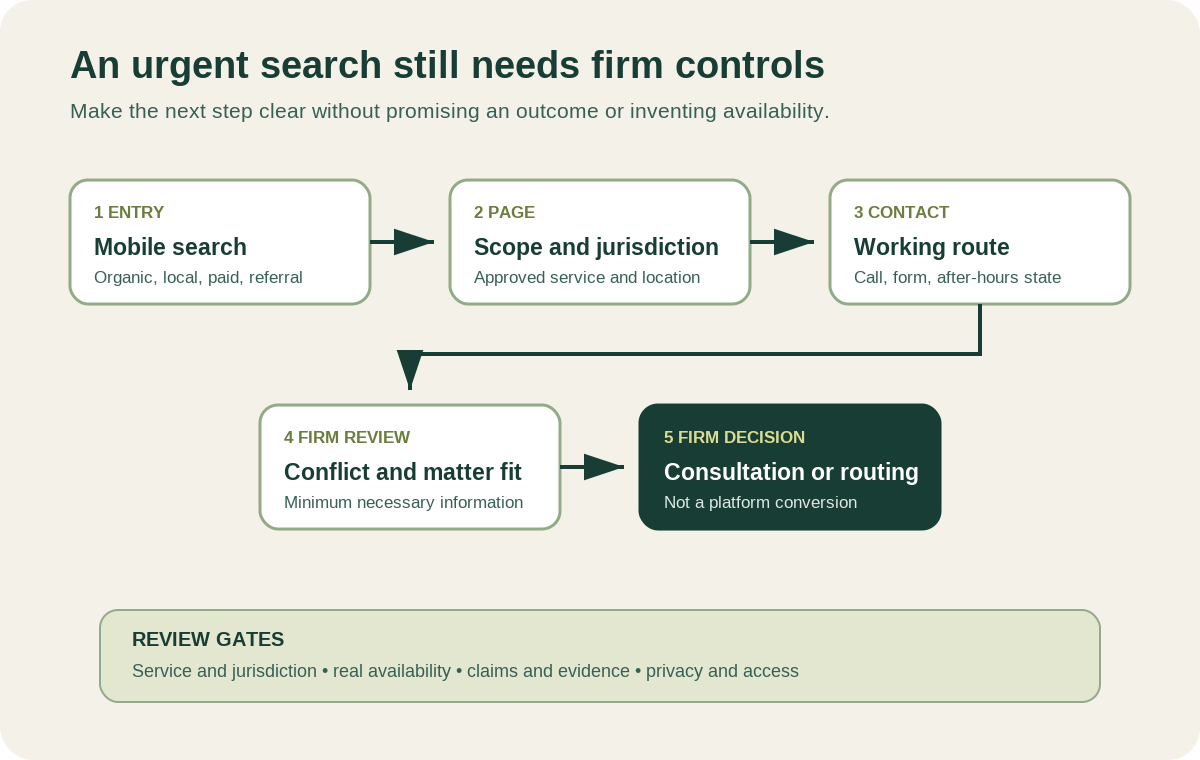
Give the urgent mobile visitor one clear next step
A person may arrive from an organic result, a local profile, an advertisement, a referral or a direct brand search. On a phone, the useful decision is usually simple: confirm that the page appears relevant, understand how to contact the firm, and know what information should wait.
The first screen should identify the service category and geography without a long claim about rankings or results. A visible phone link needs a real destination. A form needs a clear purpose, usable labels, an error state and a confirmation that does not pretend a lawyer has accepted the matter.
The site should accurately explain:
- when the phone or form is monitored;
- whether voicemail, email or text may be used;
- what the person should not send through a public form;
- whether a conflict check comes before detailed discussion;
- that an initial contact does not itself confirm representation;
- where existing clients should send documents; and
- how the firm handles requests outside its accepted services or geography.
Do not publish “24/7” because a call can reach an answering service. Confirm who answers, what they can do, when a lawyer reviews the message, and whether every advertised channel is covered during the stated hours. If the route changes after hours, test both states.
The law firm website conversion guide covers phone, form, confirmation and analytics testing in more detail. The broader law firm website design service explains ownership, launch and accessibility requirements.
Keep local profiles tied to real offices and practitioners
Google's Business Profile guidelines call for accurate real-world representation. They contain specific rules for addresses, virtual offices, co-working spaces, business hours and individual practitioners. A city page does not create an office, and a rented mailing address does not make a location eligible.
For each firm or practitioner profile, keep an operating record with:
- the entity or practitioner represented;
- the verified owner and authorized managers;
- the real-world name and primary category;
- the address, signage and customer-facing status;
- regular, special and holiday hours;
- the main phone, any tracking number and who controls each number;
- the website page linked from the profile; and
- the recovery process if ownership, verification or routing fails.
A criminal defence campaign may serve several communities from one real office. The website can explain genuine service coverage, but profile eligibility must follow the platform's rules and the firm's actual arrangement. Do not create duplicate profiles or keyword-stuffed names to simulate proximity.
Read the local SEO guide for Canadian law firms and the Google Business Profile guide before changing firm or practitioner listings.
Build service pages from approved facts
Each substantial service page should answer a distinct client task. Useful components normally include:
- the firm-approved service and jurisdiction;
- the situations the page is intended to address, without predicting a legal result;
- the lawyer or team connected to the service;
- the firm's real initial-contact process;
- current primary sources when public procedure or terminology needs support;
- a visible review date and maintenance trigger; and
- contextual links to the relevant lawyer, office, related service and contact route.
Google's people-first content guidance recommends creating material for an intended audience rather than publishing pages primarily to manipulate search rankings. That supports a simple editorial test: would this page help someone understand the firm's scope and next step if the search engine disappeared?
Question content can come from recurring, anonymized intake themes, search performance and lawyer interviews. Do not paste messages, police documents, court records, names, allegations, dates or unusual fact patterns from a file into an editorial backlog. A set of ordinary details can identify a person when combined.
The law firm content marketing guide explains source, rights, review and refresh controls for a larger publishing program. The practice-area page guide provides a detailed page-review checklist.
Review claims as a complete representation
Headlines, calls to action, photographs, testimonials, case results, fee statements, lawyer descriptions and disclaimers create one overall impression. Review them together.
The Law Society of British Columbia's Chapter 4 is one provincial example. It applies to marketing undertaken or authorized by a lawyer and addresses material that is false, inaccurate, unverifiable, reasonably capable of misleading or contrary to the public interest. Its commentary also discusses marketing that may take advantage of vulnerability or create an unjustified expectation about results. Other regulators and jurisdictions have their own rules.
The Competition Bureau explains that the general impression of a representation matters alongside its literal meaning. A disclaimer at the bottom of a page does not automatically repair a headline or image that creates a different impression.
Use a claims register for statements about:
| Claim type | Evidence to retain | Review question | Removal trigger |
|---|---|---|---|
| Service and jurisdiction | Responsible lawyer's current confirmation | Does the firm accept this work and can the named lawyer act there? | Service, lawyer or jurisdiction changes |
| Availability and response | Staffing schedule, routing test and escalation owner | Is the advertised route monitored as described? | Coverage, vendor or phone system changes |
| Experience, credentials or designation | Verifiable biography and regulator record where appropriate | Is the wording current, specific and permitted? | Role, status or credential changes |
| Result, testimonial or comparison | Source record, context, consent and required review | Could the complete presentation imply a likely outcome or superiority? | Consent, context, rule or evidence changes |
| Fee or consultation statement | Firm-approved written terms and effective date | Are conditions and exclusions clear? | Price, eligibility or consultation policy changes |
This process does not replace lawyer approval. It gives the responsible reviewer the exact words, evidence, context and expiry date to assess.
Collect less before the firm can assess the contact
A public criminal defence inquiry can contain identity information, allegations, location, immigration concerns, employment facts, health information, financial details and information about other people. The first form should not invite a complete narrative, photographs or documents by default.
The Office of the Privacy Commissioner of Canada's meaningful-consent guidance says key information about collection, use and disclosure should be understandable and accessible. It also explains that express consent is generally required for sensitive information, unexpected practices or meaningful residual risk. That guidance does not determine which privacy law applies to a particular firm or make a form compliant.
A qualified reviewer must decide:
- what information the firm can collect at the first step;
- why each field is necessary;
- how notice and consent work;
- where calls, forms and messages are stored;
- which vendors and staff can access them;
- how conflict checks are separated from marketing reporting;
- when detailed facts move to a secure channel;
- how long the information is kept; and
- what happens after a privacy or routing incident.
The Law Society of British Columbia's Chapter 3 is one professional-conduct source addressing confidential information. The firm's lawyers must determine when duties arise and how they apply. Marketing staff should not make that legal determination or copy identifiable intake material into advertising systems.
Use broad, approved categories in reports. “Impaired-driving inquiry, outside service area” may be enough for campaign review where the firm has approved that classification. The report usually does not need the person's account of the incident.
Separate traffic, contact, fit and response
An impression, click, call, form submission, answered contact, conflict-cleared inquiry, consultation and retained matter are different events. Label them separately so marketing activity is not mistaken for a firm decision.
| Stage | Recorded signal | Owner and quality check | Decision it can support |
|---|---|---|---|
| Visibility | Search impression, local-profile view or paid impression | Channel owner checks date range, filters and source | Whether the approved page appeared in the measured channel |
| Visit | Landing-page click or session | Analytics owner checks consent, attribution and duplicate rules | Whether measured visitors reached the intended page |
| Contact attempt | Call, form or approved message | Website and phone owners test routing, spam handling and confirmations | Whether the contact path worked |
| Response | Answered call or documented follow-up within the firm's defined window | Intake owner reviews coverage and exceptions | Whether advertised availability matches operations |
| Matter fit | Approved service, geography, timing and conflict status | Intake team applies a documented classification | Whether targeting and page scope need adjustment |
| Consultation | Booked and completed consultation recorded separately | Firm system owner distinguishes completed, cancelled and no-show states | Whether scheduling and follow-up are working |
| Retained matter | Firm-defined engagement record | Authorized firm owner with access and privacy controls | Business analysis using the firm's actual records |
Google Search Console reports clicks, impressions, click-through rate and average position under its own counting rules. Google Analytics defines its recommended generate_lead event as a form submission or request for information. Neither platform decides whether the firm answered, cleared a conflict, accepted the matter or entered a retainer.
Report the underlying counts, date range, exclusions, source and attribution model. A fast response percentage without its sample size and definition can mislead. A call-tracking recording is also sensitive operational data, not raw material for a marketing deck.
Test the full path before buying more attention
Run a release test from each major entry point:
- open the organic, local, paid or referral destination on a phone;
- confirm title, service, jurisdiction, office and availability statements;
- use every phone, form and approved message route;
- inspect the missed-call, voicemail, confirmation and after-hours states;
- verify that the message reaches the authorized intake owner;
- confirm the conflict and matter-fit statuses can be recorded without exposing unnecessary detail;
- test keyboard access, labels, error messages, table scrolling and responsive layout;
- verify canonical metadata, indexability, sitemap inclusion and contextual internal links; and
- record the test date, result, owner and next maintenance trigger.
Repeat the test after a phone provider, form, CRM, office, staffing, service or website release changes. A page can still rank while its contact path is broken.
What a defined engagement should produce
A useful criminal defence marketing engagement should leave the firm with:
- an approved service and jurisdiction map;
- one primary destination for each distinct client task;
- accurate office, practitioner and availability records;
- a mobile contact path with tested daytime and after-hours states;
- a claims register with evidence, owners and expiry dates;
- privacy-aware first-step intake fields and secure follow-up rules;
- separate visibility, contact, response, fit, consultation and retention definitions; and
- a maintenance calendar tied to real operational changes.
The law firm marketing hub explains how those pieces fit the wider search program. Firms can request a marketing audit to review public page structure, local visibility and the contact path. The firm remains responsible for legal, professional-conduct, privacy and advertising decisions.
Sources and limits
Sources checked November 18, 2026:
- Law Society of British Columbia, Chapter 4: Marketing of Legal Services
- Law Society of British Columbia, Chapter 3: Relationship to Clients
- Competition Bureau Canada, the general impression test
- Office of the Privacy Commissioner of Canada, meaningful consent guidance
- Google, Business Profile representation guidelines
- Google Search Central, people-first content guidance
- Google Search Console, Performance report
- Google Analytics, recommended events
These sources are current public references, not a legal opinion or a substitute for the rules and advice that apply to a particular firm. Platform documentation and professional rules can change. Record the date used, verify the current source and route jurisdiction-specific statements to the accountable reviewer before publication.