Legal content needs an accountable review process regardless of how the first draft was produced. Check the jurisdiction, claims, sources, confidentiality, and usefulness before deciding whether a page is ready to publish.
The choice is rarely AI or human from start to finish. A lawyer may define the service scope, a writer may organize the page, software may help group notes or suggest headings, and several people may review the result. The useful question is not who typed every sentence. It is whether the firm can show where the information came from, who checked it, and why the page helps a prospective client.
Small World Marketing sells content strategy, writing, review coordination and publication services to law firms. That is a commercial interest. This guide explains the controls we would expect in a responsible content workflow. It does not provide legal advice, approve a particular AI product, or replace the responsible lawyer's review.
Define acceptable drafting uses before choosing a tool
Start with the task and its risk. A low-risk outline built from an approved brief is different from a draft that interprets a new court decision or summarizes facts from a client file.
Write a short use policy before the team experiments. It should identify:
- approved and prohibited tools;
- the information that may and may not be entered;
- whether prompts or outputs are retained or used for training;
- the tasks that require a lawyer before drafting begins;
- the source and citation standard;
- the people responsible for legal, editorial and technical review;
- disclosure requirements imposed by a court, regulator, client or firm policy; and
- how drafts, approvals and corrections will be recorded.
Do not let convenience define the policy. Read the provider's current terms, privacy information, security documentation, data controls and account settings. A product name or paid plan does not establish that a tool is appropriate for confidential information.
| Drafting method | Useful role | Common risk | Required control | Accountable reviewer |
|---|---|---|---|---|
| Human-first draft | Original explanation based on an approved brief and sources | Unsupported assumptions, stale law or generic copy | Source register, factual check and legal review | Assigned writer and responsible lawyer |
| AI-assisted outline or rewrite | Organize approved material, test headings or simplify a sentence | Added facts, lost qualifications or a change in meaning | Compare line by line with the approved source material | Writer or editor, then lawyer for legal substance |
| AI-first draft | Produce a working draft from a controlled brief where firm policy permits | Fabricated authorities, wrong jurisdiction, copied patterns or plausible errors | No confidential input, full source reconstruction and manual review | Named human owner and responsible lawyer |
| Template or rule-based assembly | Reuse approved structural fields, disclaimers or office details | Stale fields, duplicated pages or incorrect combinations | Versioned source fields, duplicate check and page-level review | Content owner and technical reviewer |
No method removes human accountability. A polished paragraph can still be wrong, irrelevant or unsafe to publish.
Protect confidential and personal information before prompting
The data gate comes before drafting. Do not paste a client narrative, intake transcript, discovery material, legal opinion, internal memo, opposing-party information or identifying facts into a tool merely because the information would make the prompt more specific.
The Law Society of British Columbia's guidance on professional responsibility and generative AI tells BC lawyers to consider competence, confidentiality, supervision, information security and other professional obligations. Its confidentiality discussion recommends omitting client-identifying and confidential information from supplied material where possible. It also cautions lawyers to understand how information may be stored or reused.
The BC Code's confidentiality rules are broader than a marketing workflow. They apply to lawyers and need to be interpreted by the firm in its actual circumstances. Firms outside British Columbia need to use the rules, decisions and guidance that govern their lawyers.
Canadian privacy regulators' generative AI privacy principles recommend using anonymized, synthetic or de-identified data instead of personal information where possible. They also say sensitive or confidential personal information should be entered only when authorized.
For public website content, the safer starting point is approved public material and a fictional or abstract fact pattern. Remove names, dates, locations, combinations of facts and metadata that could identify a person. De-identification is not achieved by deleting a name if the remaining details still point to one matter.
Record the data decision:
- What information is needed for this drafting task?
- Is any of it personal, privileged, confidential or subject to a protective obligation?
- Can the task be completed with public, approved, fictional or de-identified information?
- Does firm policy permit the selected tool and account configuration?
- Who approved the input and what record will be retained?
If the team cannot answer those questions, stop before entering the prompt.
Build the evidence packet before the draft
A model response is not a source. A writer's memory is not a source either.
Create a source packet that stands on its own. For a legal guide, it may include:
- current legislation or regulation from the official publisher;
- current court, tribunal or regulator material;
- applicable professional-conduct rules and practice guidance;
- approved firm facts, services, lawyer credentials and office information;
- a list of statements the firm does not want the page to make;
- the jurisdiction and checked date for every authority; and
- the internal pages and contact route the article should support.
Save the exact destination and checked date. If the source is long, record the section, rule, paragraph or heading that supports the statement. A link to a homepage is not enough for the next reviewer to reproduce the check.
Separate source material from drafting instructions. A brief can say what the page should accomplish. It cannot prove the legal statement it asks the writer to explain.
Our practice area page review checklist shows how to connect a service, jurisdiction, primary sources, approved firm facts and intake route. The same discipline applies when AI assists with the draft.
Verify each claim by class
Reviewing a page as one block makes errors easier to miss. Classify claims and assign the right check.
| Claim class | Example | Evidence needed | Review question | Owner |
|---|---|---|---|---|
| Legal rule or procedure | Filing deadline, available remedy or court process | Current primary authority in the correct jurisdiction | Does the source support this wording and every qualification? | Responsible lawyer |
| Firm service fact | Matters handled, locations served or consultation process | Approved firm record and current service owner | Is this accurate now, and does the intake team support it? | Practice or operations owner |
| Lawyer fact | Admission, designation, role or experience | Approved biography or governing-body record where appropriate | Is the wording complete and not misleading? | Lawyer or authorized profile owner |
| Marketing or performance claim | Ranking, traffic, leads or outcome | Dated report with method, scope and limits | Is this an observed result, an estimate or a forecast? | Marketing owner |
| Search-platform statement | Google content or spam guidance | Current first-party platform documentation | Does the page state the policy without inventing a ranking factor? | Search specialist |
| General explanation | Definition, example or plain-language summary | Appropriate source plus editorial context | Will a reader understand the limit and next step? | Editor, with lawyer review where substance is legal |
Open every citation. Confirm that it resolves to the expected official source, supports the nearby wording and has not been superseded. Check quotations against the original. Do not rely on a generated case name, citation, rule number, quotation or link until a reviewer has verified it independently.
The current Google Search guidance on generative AI content says generative AI can assist research and structure, but generated output may contain inaccuracies and requires manual fact-checking. That is a useful publishing control. It does not make Google a source for legal substance.
Evaluate the draft against the prospective client's task
Correct information can still produce a poor page. A complete review asks what the reader can do after reading it.
Define one primary task. A reader may need to decide whether the firm handles a matter, prepare for first contact, understand a process at a high level, or find the appropriate official resource. The page should not attempt to cover every possible question about a practice.
Check the draft for:
- a clear scope and jurisdiction;
- a direct answer to the reader's main question;
- meaningful limits and exceptions;
- approved language about what the firm handles;
- a useful next step that matches the firm's real intake process;
- links to the relevant service, lawyer and contact pages;
- headings, tables and graphics that reduce effort instead of repeating prose;
- plain language that preserves legal meaning; and
- an update owner and a reason to revisit the page.
Ask someone who did not write the draft to explain the page's point, limits and next step. If the reviewer cannot do that, the reader probably cannot either.
Keep the lawyer and editor reviews separate
One approval checkbox hides different responsibilities.
The responsible lawyer reviews legal substance, jurisdiction, qualifications, professional claims, service boundaries and the risk of misunderstanding. The editor reviews structure, clarity, repetition, links, accessibility, source placement and consistency with the approved brief. The technical reviewer checks metadata, canonical, structured data, indexability, graphics, downloads, mobile layout and the live contact path.
The Law Society of British Columbia's AI guidance uses supervision rules as a reminder that lawyers remain responsible for work product they oversee, including technology-assisted work. That statement is specific to the cited BC guidance. It should not be converted into a claim that one review process satisfies every jurisdiction.
Record each decision separately:
| Gate | Minimum record | Pass condition | Hold condition |
|---|---|---|---|
| Data and confidentiality | Input class, tool approval and named approver | No prohibited input; authorization and controls documented | Confidentiality, privilege, privacy or tool handling is unresolved |
| Sources | Source URL, authority, jurisdiction and checked date | Every material claim has reproducible support | Missing, inaccessible, stale or mismatched authority |
| Legal | Reviewer, version, date and comments resolved | Legal substance and service boundaries approved | No qualified reviewer or unresolved legal comment |
| Editorial | Brief, reader task, link check and accessibility review | Copy is original, useful, readable and complete | Generic, duplicative, misleading or unsupported copy |
| Technical | Build, metadata, canonical, sitemap, assets and form tests | Production artifact passes defined checks | Broken route, asset, link, form or indexability signal |
| Publication | Final version, commit, live URL and verification time | Approved version is live and matches the reviewed artifact | Deployment or live verification is incomplete |
Use a review workflow that works for every drafting method
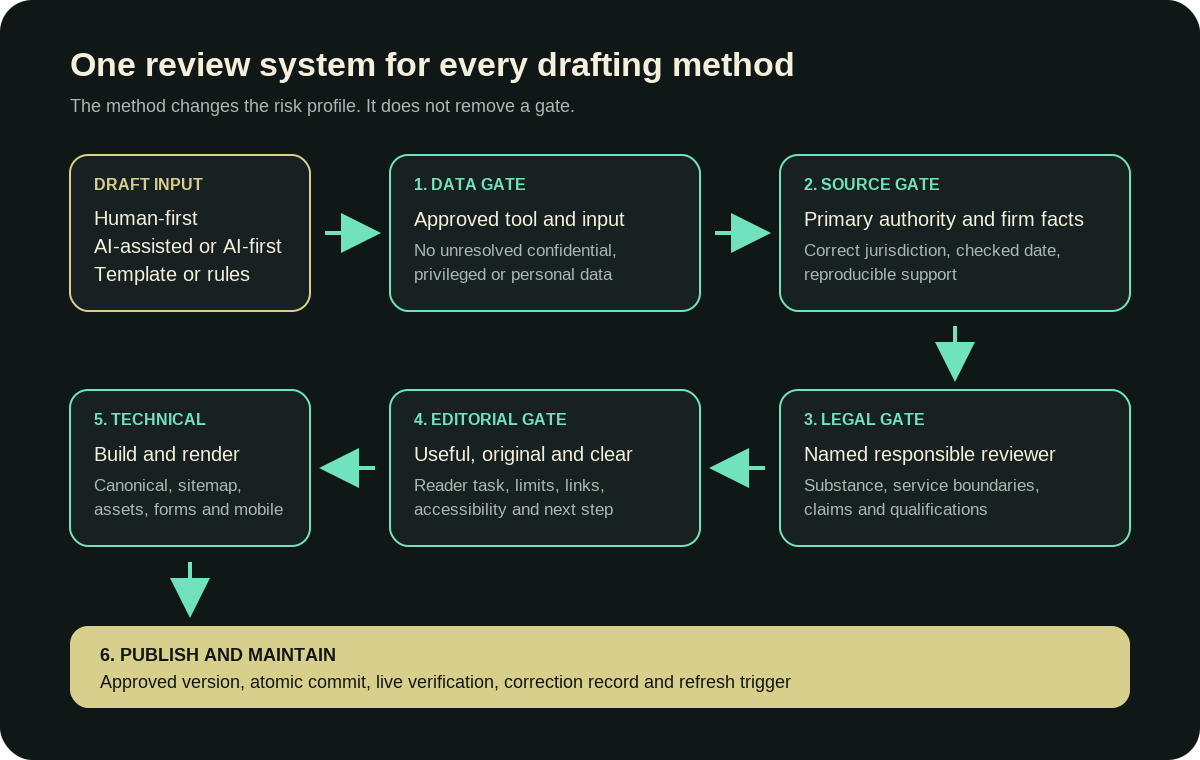
The diagram begins after the firm has decided that a page is needed. It does not assume the drafting method is safe. Human, AI-assisted and template-based drafts all enter the same gate sequence.
Download the law firm content review log to record the draft method, data classification, sources, reviewers, approval version, publication evidence and maintenance trigger.
Do not turn AI authorship into a ranking claim
Google does not present a simple rule that human text ranks and AI text does not, or the reverse.
Google's people-first content guidance asks publishers to assess originality, completeness, sourcing, expertise, factual accuracy and the reason the content was created. Its separate generative AI guidance focuses on accuracy, quality, relevance, context and manual review.
Google's scaled content abuse policy covers large amounts of unoriginal, low-value content created mainly to manipulate rankings, no matter how it was created. AI can be one production method used in abusive scaling. Human production is not a safe harbour for low-value, search-manipulation pages.
Do not turn that guidance into a promised result. A review process can reduce known publication risks. It cannot guarantee rankings, traffic, AI citations, inquiries or retained clients.
For each page, record the evidence that matters:
- the reader task and approved brief;
- the source and legal review record;
- the live canonical and indexability;
- crawl and indexing status where observable;
- relevant visits and internal paths;
- inquiries that can be responsibly attributed; and
- corrections or refreshes made after publication.
The drafting label is context. The quality and accountability record is the working evidence.
Record approval, corrections and maintenance
Save the final approved version, not only a chat transcript or an exported document with an unclear owner. The record should connect the content to its sources and live destination.
At minimum, retain:
- page path and title;
- draft method and named human owner;
- source register and checked dates;
- data classification and tool approval;
- legal, editorial and technical reviewers;
- the version each reviewer approved;
- comments and how they were resolved;
- publication commit and live verification;
- next scheduled review; and
- events that require an earlier review.
Useful refresh triggers include a change to cited law or guidance, a change to the firm's service or intake process, a broken primary source, a material correction, a new jurisdictional requirement, or a tool-policy change that affects the drafting record.
Publish a correction when the live page is wrong. Do not quietly change a legal statement and leave the old approval date in place. Record what changed, why, who reviewed it and when the corrected version went live.
Reject a draft when the evidence cannot be recovered
Some drafts cost more to repair than to replace.
Reject or restart when:
- citations do not exist or do not support the statements;
- the draft mixes jurisdictions without making the distinction clear;
- confidential or personal information was used without a resolved authorization and handling record;
- the writer cannot identify which passages came from which sources;
- the copy invents credentials, experience, offices, results or client facts;
- legal qualifications were removed to make the prose sound simpler;
- the page duplicates an existing destination without a distinct reader task;
- the draft was scaled from a pattern without page-level review; or
- the responsible reviewer cannot approve the version that will be published.
A deadline does not fix an evidence gap. Hold the page, preserve the draft and document the next action.
Apply the controls to the next page
Choose one proposed destination and run the process end to end. Start with its reader task, approved service scope, jurisdiction and sources. Decide which drafting method fits only after those inputs are clear.
The law firm content marketing service explains how Small World Marketing organizes page inventory, research, drafting, review, publication and maintenance. See the broader law firm marketing guide for the connection to service pages, local visibility, paid search and intake.
If you want us to review the current content system, request a law firm marketing audit. Bring the website, priority practice areas, real service locations, current review process and the intake issues the team already sees.
Sources and limits
The official sources below were checked on November 27, 2026:
- Google Search's guidance on using generative AI content;
- Google's helpful, reliable, people-first content guidance;
- Google's scaled content abuse policy;
- the Law Society of British Columbia's Guidance on Professional Responsibility and Generative AI;
- Chapter 3 of the Code of Professional Conduct for British Columbia; and
- the Office of the Privacy Commissioner of Canada's principles for privacy-protective generative AI.
Professional duties, court requirements, privacy law, service scope and product behaviour vary by jurisdiction, matter, tool and configuration. The firm must apply the current rules and instructions that govern its work. This page is a marketing operations guide, not a legal opinion or approval of a particular workflow.